
Northeast Bohemia
Adršpach
A labyrinth of sandstone towers that feels less like Europe and more like a Miyazaki film.
"The first time I walked into the Adršpach rock city as a child, I genuinely thought I had stepped into a fairy tale. Twenty-five years and a hundred visits later, it still feels that way."
01
Chapter One
Overview
The Adršpach-Teplice Rocks (Adršpašsko-teplické skály) are a national nature reserve in north-eastern Bohemia, roughly 170 kilometres east of Prague near the Polish border. Two adjacent rock cities — Adršpach and Teplice nad Metují — form the largest sandstone rock landscape in Central Europe, protected since 1933 and covering more than 17 square kilometres of towers, canyons, forests and viewpoints. The Adršpach half is the more famous and dramatic; the Teplice half is quieter and better for longer hikes.
It is one of those rare places in Czechia that lives up to every image you've seen. Bring good shoes, a bit of patience with the crowds in peak summer, and a full day.
02
Chapter Two
Why Visit Adršpach
Adršpach is the closest thing Czechia has to a fantasy landscape. The comparison people reach for most often — Zhangjiajie in China, the sandstone hoodoos of the American Southwest, the rock forests of Meteora — is not far off. Vertical pillars up to 100 metres tall crowd against each other in a labyrinth so dense that daylight barely reaches the sand paths at the bottom, and the whole thing sits in a temperate Central European beech and pine forest with an emerald lake in the middle of it. Nowhere else in Central Europe combines rock formations of this scale with this kind of easy, well-marked access.
It is also one of the few genuinely unique natural landscapes in Czechia. The country's mountains are gentle, the forests calm, the rivers modest — beautiful, but rarely dramatic. Adršpach is dramatic in a way that surprises even Czechs. It has been used as a filming location for The Chronicles of Narnia: Prince Caspian and several period fantasy productions, and it earns every second of screen time.
Chapter Three
Top Things To See in Adršpach
Six landmarks give you the full arc of the reserve — a rock-city labyrinth, its most beloved pair of pillars, an emerald lake with a boat ride, a natural Gothic gate, a two-tiered waterfall, and the ridge viewpoints that reveal the whole thing from above.
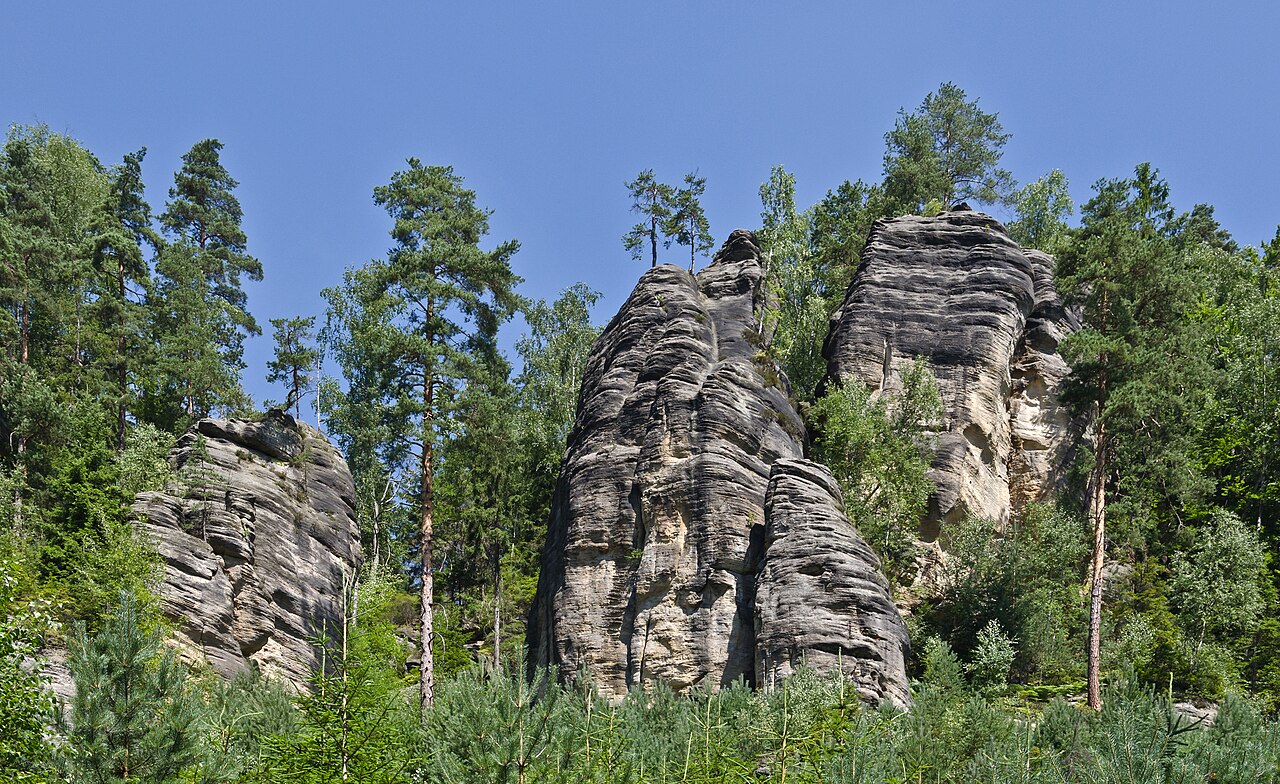
Adršpach Rock City
The Adršpach Rock City (Adršpašské skály) is the beating heart of the reserve — a labyrinth of sandstone towers, needles and canyon walls rising up to 100 metres from a shaded forest floor. The formations were carved over 70 million years by wind, rain and ice from a former sea bed, and today form one of the largest rock cities in Central Europe. Wooden walkways and sand paths thread between the pillars, past narrow slot canyons and mossy grottos where light barely reaches. Individual formations carry names locals have used for generations — the Mayor, the Sugar Loaf, the Elephant Square — and you keep looking up in disbelief that the whole thing is real.
Local Tip
Enter through the main gate at Adršpach village and follow the marked yellow circuit anticlockwise. It gets you to the most dramatic formations before the coach groups reach them from the opposite direction around 10:30.
Book Ahead
Adršpach Rock City Tickets
Timed entry and parking can sell out on summer and autumn weekends — reserve before making the journey.

Lovers' Rock (Milenci)
Two impossibly slender sandstone pillars leaning gently toward each other, the Milenci — Lovers — are the most photographed formation in the reserve and the emotional centre of the loop. Local legend says a pair of doomed lovers were turned to stone by a jealous count and stand here waiting for each other still. Whether or not the story moves you, the pillars are geologically improbable: needle-thin, over 100 metres tall, held up by the compressive strength of tightly cemented Cretaceous sandstone. A small clearing directly beneath them lets you crane your neck straight up.
Local Tip
The best photograph is not from the base but from a small side path about 40 metres before the clearing — you get both pillars framed by the forest canopy with a sense of scale.

Adršpach Lake (Adršpašské jezero)
Deep inside the rock city, a narrow flooded quarry has become one of the most photographed swimming spots in Czechia — an emerald-green lake enclosed on all sides by vertical sandstone walls that glow amber in afternoon light. Small wooden punts run a short guided ride (about 10 minutes) with a rock-city keeper poling the boat and reciting the legends in Czech and — in high season — English. The water is cold, still and startlingly clear, and the tiny beach at the far end is one of the few places in the reserve where you can sit down and just look up.
Local Tip
Boat rides run continuously in summer but queues can hit 45 minutes at midday. Do the boat first thing after the gate opens, or save it for after 16:00 when day-trip groups have left.

Gothic Gate (Gotická brána)
A natural sandstone arch on the northern half of the circuit, framed so cleanly that early visitors named it the Gothic Gate — the opening looks pointed like a cathedral portal, with hanging moss curtains on the flanks. It marks the transition from the main basin of the rock city into the quieter waterfall valley, and it is one of the very few points on the loop where you can stand fully inside a formation and feel the mass of stone overhead.
Local Tip
Stop, wait five minutes, and let the group ahead move on. In the silence you can hear water dripping through the sandstone above you — worth the pause.

Great Waterfall (Velký vodopád)
The Great Waterfall drops about 16 metres in two clean tiers down a moss-blackened rock wall, fed by the small Metuje stream at the far end of the rock city. In dry summer months the flow is modest, but after heavy spring rain or a storm it thunders — a genuinely dramatic sight in the middle of the forest. A small dam upstream can be released for scheduled artificial cascades in summer, timed so the boat rides on the lake coordinate with the water show. Wooden footbridges cross directly below the falls.
Local Tip
Check the summer schedule at the ticket office on arrival — the artificial release usually runs a few times a day between June and August and turns a trickle into a real waterfall for about 10 minutes.

Sandstone Tower Viewpoints
The full magnitude of the rock city only becomes clear from above. Three signposted viewpoints on the ridges around the reserve — <em>Křížový vrch</em> (Cross Hill, 611 m), <em>Panorama</em>, and the higher <em>Čáp</em> (786 m) between Adršpach and Teplice — reward a short but steep climb with a sea of sandstone towers rippling to the horizon. Čáp in particular gives you the classic aerial view of the whole reserve, best in soft morning light. Add 60–90 minutes to your loop for each viewpoint.
Local Tip
If you only have time for one, choose Křížový vrch — 20 minutes uphill from the main circuit, wooden staircase for the last section, and a wide platform with the definitive view over the rock city.
04
Chapter Four
The Best Hiking Route: The Great Circuit
The classic Adršpach experience is the Great Circuit (Velký okruh), a well-marked yellow-blazed loop that starts and ends at the main entrance next to Adršpach railway station and takes in every major formation on this side of the reserve.
Distance: approximately 3.5 kilometres for the core loop, or 5.5 kilometres if you add the Křížový vrch viewpoint.
Duration: 2.5–3.5 hours at a relaxed pace with photo stops; add 60–90 minutes for viewpoints and the boat ride.
Difficulty: Easy to moderate. Mostly flat sandy paths with wooden walkways; a handful of stairways and one narrow squeeze at the "Mouse Hole" (Myší díra). Not suitable for strollers or wheelchairs beyond the first 400 metres. Solid shoes required — surfaces are often damp and sandy.
Elevation gain: around 120 metres on the core loop, 280 metres including Křížový vrch.
The route. From the entrance the loop drops immediately into the rock city, passes the Elephant Square, then curves right toward the Lovers' Rock and the Sugar Loaf. It threads through the Mouse Hole squeeze and out to the Adršpach Lake and the boat pier. From the lake, the trail loops back through the Gothic Gate, past the Great Waterfall, and returns along the northern side of the basin. Add Křížový vrch as a signposted side climb about two-thirds of the way round.
Best photo spots on the circuit: the Lovers' Rock clearing (soft morning light), the Adršpach Lake pier (mid-afternoon reflections), the base of the Great Waterfall (mossy foreground, strong verticals), and Křížový vrch viewpoint at golden hour.
Local tip
Walk the loop anticlockwise. Coach groups almost universally go clockwise from the entrance, so you meet them briefly rather than shuffling behind them for three hours.
05
Chapter Five
Best Time To Visit
Spring (April–May). My personal favourite. Snowmelt swells the Metuje stream and the waterfall thunders naturally, the beech canopy is a soft translucent green, and visitor numbers are still low — you can have whole stretches of path to yourself on a weekday. Mornings are cold (4–8 °C), afternoons mild (12–18 °C). Book accommodation freely.
Summer (June–August). The busiest and warmest season, with lush forest, warm sand paths and full boat rides on the lake. Also the most crowded — weekends can see 5,000+ visitors, queues of an hour for the boat, and full car parks by 10 a.m. If summer is your window, come on a weekday, arrive at opening (usually 8:00), and pre-book parking. Daytime temperatures 20–28 °C, cooler in the shaded canyons.
Autumn (mid-September to late October). The other truly special season. Beech and larch turn copper and gold, morning mist pools in the canyons, and the golden-hour light on the sandstone is unforgettable. Weekends can still be busy in early October — go midweek if you can. Crisp days (10–16 °C), cold mornings, occasional rain.
Winter (December–March). Quiet, atmospheric and quietly magnificent. Frosted formations, ice curtains on the waterfall, snow on the walkways. The main circuit is usually kept open (with limited hours and closures during ice-fall risk) and there are guided ice-climbing tours on the frozen falls. Dress properly — temperatures often below −5 °C in the canyons, which trap cold air.
06
Chapter Six
How To Get There
Prague to Adršpach by train. The most enjoyable option and the one I recommend. Direct trains run from Prague hl.n. to Adršpach station (yes — the station is right at the reserve entrance) several times a day, taking about 3 hours 15 minutes with a single change at Choceň or Trutnov. Round-trip tickets are typically 350–500 CZK. RegioJet and České dráhy both operate the route; RegioJet's seasonal weekend "Adršpach Express" runs direct from Prague in about 3 hours.
Prague to Adršpach by car. About 170 kilometres north-east on the D11 motorway, then the 33 to Náchod and local roads via Teplice nad Metují — normally 2 hours 15 minutes, longer on summer weekends. The drive is straightforward and scenic through rolling Bohemian countryside.
Parking. Two large paid car parks operate at the main entrance — P1 Adršpach (closest, fills first, around 200 CZK per day) and P2 a short walk further back. In summer and on autumn weekends, pre-book online at the reserve's official website (skalyadrspach.cz) — walk-in parking is regularly full by 10:00 and cars are turned away.
Entry. The reserve is ticketed. Adult tickets are around 180 CZK in high season, discounted in winter; children, students and seniors half price. The Adršpach Lake boat ride is a small extra fee paid at the pier. Timed entry slots apply on summer weekends — again, book online in advance. Bring cash as a backup for the boat and the small food kiosks inside the reserve.
07
Chapter Seven
Photography Guide
Best viewpoints. Three deliver the definitive images. Křížový vrch (611 m, 20-minute climb from the main circuit) is the classic wide panorama over the rock city — best at sunrise or in soft mid-morning light. Čáp (786 m, longer 90-minute climb from Teplice) gives the highest aerial angle over the whole reserve and is worth a dedicated half-day. Panorama, on the ridge west of Adršpach village, is the easiest of the three (about 30 minutes uphill) and pairs beautifully with sunset.
Sunrise and sunset. Sunrise on the pillars from Křížový vrch or Panorama is genuinely special — pinkish-orange light rakes across the sandstone and picks out every ledge. Sunset is more diffuse (the ridges to the west block direct light on the rocks themselves) but Čáp and Panorama both catch the last warm glow on the tops of the tallest towers. Golden hour lasts about 40 minutes in summer, 25 in autumn.
Most photogenic locations inside the loop. The Lovers' Rock from the small side path 40 metres before the base clearing; the Adršpach Lake from the pier around 15:00–16:00, when afternoon light turns the water emerald and reflects the enclosing walls; the Gothic Gate from directly beneath the arch looking out toward the forest; the Great Waterfall from the lower footbridge with the mossy rock face as backdrop; and the narrow canyon just past the Mouse Hole, where two towers frame a shaft of light around midday.
Practical. A 24–70 mm zoom covers 90% of what you need; a wide 16–35 mm helps in the tightest canyons. Tripods are permitted on paths but not on side scrambles or the boat. Weather in the reserve changes fast — bring a rain cover for your camera even on clear days.
Local tip
If you're serious about photography, stay overnight in Adršpach village and be at the entrance when it opens. The first 90 minutes of the day — before the day-trippers arrive from Prague and Wrocław — are worth every early alarm.
08
Chapter Eight
Nearby Attractions
Teplice Rocks (Teplické skály). The other half of the same reserve, three kilometres south of Adršpach. Fewer visitors, longer trails, and formations that feel more remote and wild — the Sibiř ("Siberia") section and the sandstone tower ridge behind Chrámové stěny are highlights. A dedicated blue trail links the two rock cities in about 2 hours of walking; do them together on a two-day visit.
Broumov (18 km east). A small Baroque town with a hilltop Benedictine monastery of national importance — the Broumov Monastery library and the wooden Church of the Virgin Mary in nearby Broumov-Poland are the highlights. The surrounding Broumovsko protected landscape is a rolling agricultural region with unusual sandstone rock formations of its own (Ostaš, Křížový vrch above Police nad Metují).
Náchod (25 km south). A likable regional town on the Polish border dominated by Náchod Castle, a Renaissance chateau with a good weapons collection and formal gardens. A convenient base if Adršpach and Teplice accommodation is full, or if you're crossing to Poland (Kudowa-Zdrój and Wrocław are both reachable from here).
Krkonoše Mountains (40 km north-west). The Czech Republic's highest range, including Sněžka (1,603 m), Špindlerův Mlýn ski resort and the source of the Elbe. If you're already this far east, a two-day extension into the Krkonoše — a summit hike to Sněžka in summer, a proper ski trip in winter — makes the trip out from Prague hugely more rewarding.
Chapter Nine · FAQ
Frequently asked.
Is Adršpach worth visiting?+
Yes — unreservedly. It is the most visually unique natural landscape in Czechia and one of the most impressive sandstone rock cities in Europe. If you have any interest in landscapes or photography, it is a highlight of any Czech trip.
Can I do Adršpach as a day trip from Prague?+
Yes, but it's a long day — 3 hours each way by train, plus 3–4 hours in the reserve. Doable, and thousands do it. But an overnight stay in Adršpach village or nearby Teplice nad Metují lets you catch sunrise, avoid the coach-group hours, and combine the Adršpach and Teplice rocks properly.
How long do I need in Adršpach?+
The main circuit takes about 3 hours. Add the boat ride, one ridge viewpoint and lunch and you're at 5–6 hours — a full day. For both rock cities and multiple viewpoints, plan two full days.
Do I need to book tickets in advance?+
In summer (June–August) and on autumn weekends — yes, book online. In winter and on weekdays outside high season, walk-in tickets are fine.
Is Adršpach suitable for children?+
Yes, and children love it. The main circuit is easy and the rock formations feel genuinely magical to kids. The Mouse Hole squeeze and the boat ride are highlights. Bring proper shoes and a light layer even in summer — the canyons are cool.
Are dogs allowed?+
Yes, on a lead. Note the boat ride does not allow dogs.
Can you climb the rocks?+
Sport climbing on the sandstone is permitted only for registered climbers on designated towers with strict rules protecting the fragile rock. Casual scrambling is forbidden and enforced — stay on the marked paths.
What should I pack?+
Solid walking shoes with grip (sand and damp wood), a light layer for the cool canyons, a rain jacket, water, snacks, cash for the boat and kiosks, and — if you can — a camera with a wide lens.
Continue exploring
Nearby & related destinations


The Wonders Dispatch
Get Czechia travel tips, itineraries and hidden gems delivered by a local.
One quiet letter a month from Lukáš in Prague. No spam, no sponsored fluff — just the notes I'd send a friend planning their trip.
Free · Unsubscribe any time · Read by travelers in 40+ countries