Moravia
Brno
Czechia's second city — modernist architecture, a Gothic cathedral and a lively student pulse.
"Prague dazzles the first-time visitor. Brno wins the second-time visitor — the one who wants great coffee, honest food, and a Czech city that still feels like itself."
01
Chapter One
Overview
Brno is the capital of Moravia and Czechia's second city — a compact, walkable place of about 380,000 people set in a bowl of green hills where two rivers meet. Its skyline is defined by two silhouettes on facing hills: the Baroque bulk of Špilberk fortress to the west, and the twin Neo-Gothic spires of the Cathedral of St. Peter and Paul to the south. Between them lies a dense old town of Gothic churches, Renaissance townhouses, Functionalist masterpieces from the interwar years, and a growing scene of specialty coffee bars and craft breweries.
It is a university town — around one in five people you pass in the centre is a student — which gives Brno its youthful, unpretentious energy. And because it has been overshadowed by Prague for so long, it has been spared the worst of mass tourism: even in July, the cafés on Jakubské náměstí and the beer gardens along the Svratka feel like they belong to the people who live here.

02
Chapter Two
Why Visit Brno
Brno is quietly one of Europe's most underrated city breaks. It offers a UNESCO-listed masterpiece of modern architecture (Villa Tugendhat), a proper hilltop fortress with sweeping views, an atmospheric old town you can walk end to end in twenty minutes, one of the best specialty coffee scenes in Central Europe, and a serious craft-beer culture that has come of age in the last decade. Add a compact food scene that blends Moravian classics with young chef-owner bistros, and you have far more than a "second city" — you have one of the most rewarding two-night stops in the country.
The other thing Brno gives you is context. See it after Prague and Czechia stops feeling like a single city with a hinterland: you understand it as a country of two cultural halves — Bohemia and Moravia — with different landscapes, different food, different wines, and a different pace of life. Two days here reframes the whole trip, and puts you within easy reach of Mikulov, Lednice-Valtice, the Moravian Karst and Olomouc for onward days.
Chapter Three
Top Things To Do in Brno
Six landmarks give you the shape of the city — a fortress, a cathedral, a modernist villa, a Gothic town hall, a working market and the tunnels beneath the streets. Book Villa Tugendhat well ahead; everything else you can plan on the day.

Špilberk Castle
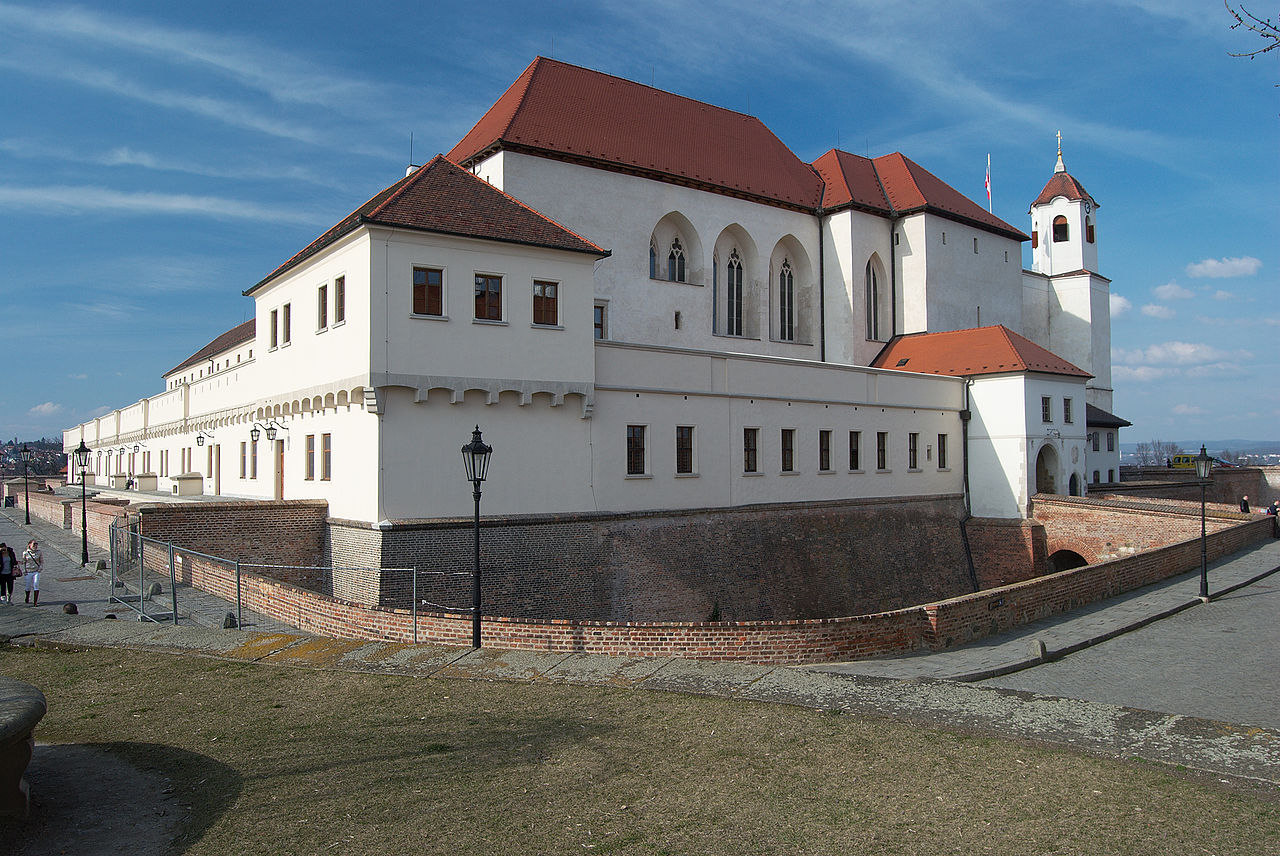
Špilberk crowns the highest hill in central Brno — a 13th-century royal castle turned Baroque fortress turned notorious Habsburg prison, its ramparts now wrapped in a public park that locals use as their back garden. Founded by King Přemysl Otakar II around 1240, it withstood the Swedes in the Thirty Years' War, held Italian and Polish revolutionaries in its casemates in the 19th century, and today houses the Brno City Museum with excellent exhibitions on the city's history, architecture and the grim prison years. The views from the bastions sweep over the red rooftops of the old town toward the twin spires of the cathedral.
Local Tip
Walk up through the park from the western side (Údolní street) rather than the direct steps — the winding path is shaded, easier on the knees, and delivers you at the prettiest gate. Buy the combined ticket that includes the casemates.

Cathedral of St. Peter and Paul
Perched on Petrov hill directly across from Špilberk, the Cathedral of St. Peter and Paul is Brno's defining silhouette — two soaring Neo-Gothic spires added at the start of the 20th century to a much older Romanesque and Gothic church. The interior is calm and pale, with beautifully carved choir stalls and a small treasury. Petrov is also home to the city's most famous quirk: the cathedral bells ring noon at 11 a.m., a tradition dating from the Swedish siege of 1645, when the townspeople reputedly tricked the exhausted attackers into abandoning the siege by ringing the noon bells an hour early.
Local Tip
Climb one of the towers (small fee, narrow spiral staircase) for the single best rooftop view in Brno — cathedral, Špilberk, old town and the green Moravian hills all in one frame.

Villa Tugendhat
Villa Tugendhat is why architects fly to Brno. Designed by Ludwig Mies van der Rohe for a young Jewish industrialist family and completed in 1930, it is one of the founding works of modern architecture and a UNESCO World Heritage Site — a flat-roofed, glass-walled pavilion built into a hillside north of the centre, with a single vast living space defined by an onyx wall that glows amber in the winter afternoon. The Tugendhats fled the Nazis in 1938 and the house was later returned to the city and painstakingly restored in the early 2010s. Guided tours (English, 60 or 90 minutes) show the living rooms, the servants' floor and Mies's original ingenious ventilation systems.
Local Tip
Tickets sell out weeks — sometimes months — in advance. Book online through the villa's official website (tugendhat.eu) the moment you know your travel dates. If you miss out, the garden ticket is a good consolation and can usually be bought on arrival.

Old Town Hall & the Brno Dragon
The Old Town Hall (Stará radnice), a few steps off Zelný trh, is Brno's oldest secular building and home to the city's two beloved legends: the Brno Dragon (in reality a stuffed crocodile presented to the city in the 17th century, now hanging in the entrance passageway) and the Brno Wheel, an oak wagon wheel that a young cartwright is said to have felled a tree, made and rolled the 50 kilometres from Lednice to Brno in a single day to win a bet. Beyond the legends, the Gothic portal by Anton Pilgram — with its famously twisted central pinnacle — is one of the loveliest pieces of stonework in the city, and the tower offers a compact, close-up view over the old town roofs.
Local Tip
Entry to the passageway with the dragon and wheel is free. The tower has a small fee and a tight spiral climb — combine it with a stop for coffee at nearby Café Podnebí or SKØG Urban Hub afterwards.

Zelný trh (Cabbage Market)
Zelný trh — literally the Cabbage Market — is the working heart of the old town and has been a market square since the 13th century. Farmers from the surrounding Moravian villages still set up stalls here six mornings a week, piled with seasonal fruit, wild mushrooms, apricots in July, cabbage in October, and local cheese and honey year-round. The Baroque Parnas Fountain by Fischer von Erlach anchors the sloping cobbled square, and beneath it lies the entrance to the Labyrinth (see below). It is the best place in Brno to feel the city working rather than performing for tourists.
Local Tip
Come between 8 and 10 a.m. on a weekday for the busiest, freshest market. Grab a coffee and a čerstvý (fresh) buchta from one of the stalls and eat it on the fountain steps — the classic Brno breakfast.

Brno Underground (Labyrinth & Ossuary)
Brno sits on a network of cellars and tunnels dug over five centuries as beer and wine stores, granaries and refuges from siege. Two are open to the public and easy to combine in an hour. The Labyrinth Under Zelný Trh is a chain of 13th–17th-century cellars beneath the market square, now atmospherically restored with reconstructed alchemists' workshops and a plague-era pharmacy. The Brno Ossuary beneath the Church of St. James is Europe's second-largest (after Sedlec) and one of its most powerful — the bones of an estimated 50,000 people, victims of medieval plagues and wars, arranged in solemn geometric patterns beneath a low vaulted ceiling.
Local Tip
The Ossuary entrance is on Jakubské náměstí and easy to walk past — look for a discreet stone stairwell descending from street level. Photography is allowed but respectful silence is expected; children under about 10 may find it intense.
04
Chapter Four
Food, Cafés & Local Life
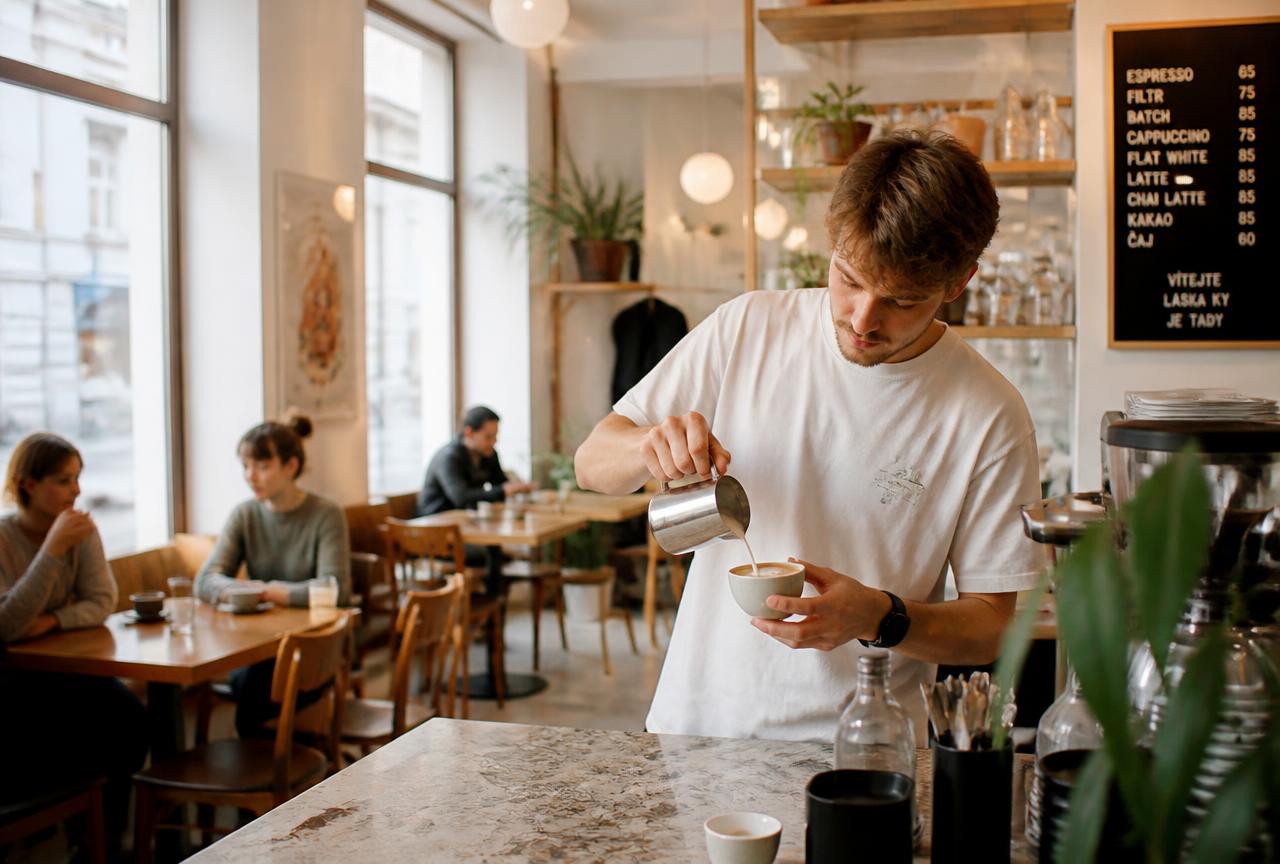
Café culture. Brno takes coffee seriously — arguably more seriously than Prague. The scene revolves around a handful of pioneering roasters and their flagship bars: Café Podnebí in a hidden courtyard near the cathedral, the airy two-floor SKØG Urban Hub on Dominikánské náměstí, Kafec for a quieter neighbourhood feel, and Industra Coffee in the up-and-coming Zábrdovice district for serious specialty pour-overs. Expect flat whites made by people who know what they are doing, and rotating single-origin beans roasted in Brno itself.
Local restaurants. For classic Moravian cooking — roast duck, svíčková, potato dumplings and heavy Moravian wine — try Pavillon in a restored 1920s Functionalist pavilion, or the more traditional Lokál U Caipla on Kozí. For a more contemporary bistro dinner, Element, Borgo Agnese (Italian) and Anaddar (modern Middle Eastern) all cook well and take walk-ins if you eat early. Atelier is Brno's small-plates and natural-wine favourite.
Craft beer. Brno is one of the two capitals (with Prague) of the Czech craft-beer wave. Start at Výčep Na Stojáka, a tiny standing-only beer bar on Jakubské náměstí that pours rotating taps from small Czech and Moravian breweries; move on to Ochutnávková Pivnice for a bigger tap list, or the taproom of Pivovar Hauskrecht for excellent lagers brewed a few kilometres from the centre. In summer, everyone drifts to the beer gardens on Kraví hora or the open-air taps at Náplavka on the Svratka riverbank.
Best areas for evening walks. For sunset, walk up through the park to Špilberk and stroll the ramparts as the cathedral spires catch the last light. For a young, buzzy evening, wander Jakubské náměstí and the small streets around Česká and Dominikánská. For something more romantic, follow the river path from Náplavka south toward Pisárky park — quiet, tree-lined, and full of locals on summer evenings.
Local tip
Order coffee "na místě" (to stay) rather than takeaway — Brno's café culture is about sitting down for twenty minutes with a book or a friend, and you'll get a better cup in a proper cup for the same price.
05
Chapter Five
A Suggested One-Day Itinerary
9:00 — Coffee at SKØG Urban Hub. Start at Dominikánské náměstí with a flat white and a pastry, and take a first slow walk through the old town waking up around you.
10:00 — Old Town Hall & the Brno Dragon. Duck into the passageway on Radnická to see the "dragon" and the wheel, then climb the tower for your first orientation view.
11:00 — Cathedral of St. Peter and Paul. Walk up Petrov hill to the cathedral. Wait for the "noon" bells at 11 a.m. sharp, then explore the calm interior and (if you have the knees for it) climb one of the spires.
12:30 — Lunch on or near Zelný trh. Wander down through the market, buy fruit from a stall, then take an early lunch at Pavillon, Element or a table at U Caipla.
14:00 — Brno Underground (Labyrinth or Ossuary). Pick one: the Labyrinth beneath Zelný trh for atmosphere and history, or the Ossuary beneath St. James for a genuinely moving hour. Both take about 45 minutes.
15:30 — Špilberk Castle & park. Walk up through the park from Údolní street. Tour the museum and the casemates, then take your time on the ramparts as the afternoon light softens.
17:30 — Villa Tugendhat. If you booked ahead, take a tram (line 3 or 11) to the villa for a late-afternoon guided tour. If not, use this hour for a second coffee at Café Podnebí or a first beer at Výčep Na Stojáka.
19:30 — Dinner and a beer. A relaxed dinner at Borgo Agnese, Anaddar or Atelier, followed by a nightcap at one of the craft-beer bars around Jakubské náměstí. Walk back through the lit-up old town.
06
Chapter Six
Where To Stay
Boutique — Hotel Barceló Brno Palace, a beautifully restored 19th-century palace two minutes from Náměstí Svobody with a glass-roofed atrium and one of the best breakfasts in the city, and Grandezza Hotel Luxury Palace right on Zelný trh with elegant, quiet rooms overlooking the market. Both put you within a five-minute walk of everything.
Mid-range — Hotel Royal Ricc in a Renaissance townhouse on Starobrněnská, Cosmopolitan Bobycentrum for spacious modern rooms with skyline views, and Vaka Boutique Hotel — a small, design-forward option a short walk from the centre. Doubles typically 2,500–4,500 CZK with breakfast.
Budget — Hostel Mitte is a well-run design hostel one minute from Zelný trh with private rooms as well as dorms, and Hostel Fléda above a legendary music club offers cheap, clean beds for travellers who don't mind a livelier evening soundtrack. Airbnbs in the streets north of the old town (around Lužánky park) are excellent value.

07
Chapter Seven
How To Get There
Prague to Brno by train. The fastest, most comfortable option. Direct trains run every hour from Prague hl.n. to Brno hl.n. and take about 2 hours 30 minutes. Choose RegioJet or Leo Express for the best value and comfort — both operate modern coaches with free coffee, at-seat service and reserved seats from around 250–450 CZK if booked a few days ahead. State operator České dráhy (ČD) also runs the route at similar speed.
Prague to Brno by bus. RegioJet, FlixBus and Student Agency run frequent coaches from Prague Florenc or Praha Zličín to Brno's Grand Bus Terminal (Brno ÚAN Zvonařka), taking 2 hours 30 minutes to 3 hours. Tickets often start at 149 CZK. Buses are excellent quality in Czechia — new coaches, on-board Wi-Fi and coffee, and reserved seats. Book online in advance for the best fares.
Driving. Brno is about 210 kilometres south-east of Prague on the D1 motorway — normally 2 hours 15 minutes, but the D1 can be congested on Friday afternoons and Sunday evenings, when it can slow to 3 hours or more. Park at one of the P+R lots on the ring road and take the tram in; central parking is expensive and one-way streets make driving inside the ring frustrating.
From Vienna & Bratislava. Brno is closer to Vienna (135 km, roughly 1 hour 45 minutes by direct RegioJet train or FlixBus coach) and Bratislava (130 km, about 1 hour 30 minutes) than to Prague. If you are flying into Vienna, arriving in Brno first and finishing in Prague is a genuinely good way to structure a Czechia trip.
08
Chapter Eight
Day Trips From Brno
Mikulov (50 km south). The most rewarding day out from Brno — a Baroque chateau on a limestone cliff, a Renaissance square of pastel townhouses, and the vineyards of the Pálava Hills all around. Direct buses take about 50 minutes; by car it is under an hour on route 52. See our full Mikulov guide.
Lednice & Valtice (55 km south-east). The UNESCO-listed Lednice–Valtice Cultural Landscape — a 300-square-kilometre park designed by the Liechtenstein family, with a Neo-Gothic chateau, palm greenhouses, a Baroque wine chateau and follies scattered through English woodland. Reachable by train via Břeclav in about 90 minutes, or 45 minutes by car.
Moravian Karst & Macocha Abyss (30 km north). A dramatic limestone landscape of caves, gorges and the 138-metre-deep Macocha sinkhole. Take the guided tour of the Punkva Caves, which ends with a boat ride along an underground river. Trains from Brno hl.n. to Blansko (25 minutes) plus a short bus or taxi transfer make this a very easy half-day.
Olomouc (80 km north-east). Moravia's second historic capital and one of Czechia's most underrated old towns — a huge student population, a UNESCO-listed Holy Trinity Column, six Baroque fountains, and a beautiful astronomical clock (rebuilt in socialist realist style in the 1950s, uniquely worth seeing). Direct trains take about 1 hour 20 minutes.

Chapter Nine · FAQ
Frequently asked.
Is Brno worth visiting?+
Yes — especially if you already have Prague on your itinerary and want to see the other, less-touristed half of the country. Two nights lets you see the city itself; three or four opens up Mikulov, Lednice-Valtice and the Moravian Karst as easy day trips.
How many days do I need in Brno?+
One full day covers the main sights (Špilberk, cathedral, old town, Villa Tugendhat). Two nights is the sweet spot — one day for the city, one day for a trip into South Moravia. Three nights lets you slow right down and enjoy the café and beer culture properly.
Can I do Brno as a day trip from Prague?+
Technically yes — 2.5 hours each way by train — but you'll spend as long travelling as sightseeing and miss what makes Brno good (its evenings). Overnight if you can.
Is Brno cheaper than Prague?+
Meaningfully cheaper for food, drinks and hotels — expect prices roughly 15–25% below central Prague, and craft-beer bars that would be double the price in Prague 1. Attractions are similarly priced.
Do people speak English?+
Widely, especially in cafés, restaurants and hotels in the centre. Brno is a university city with a large international student population — you'll rarely have language trouble.
Is Villa Tugendhat really that important?+
Yes — it's a UNESCO World Heritage Site and one of the founding works of modern architecture, alongside the Barcelona Pavilion and Fallingwater. For anyone interested in architecture or design, it is reason enough to visit Brno on its own. Book online weeks ahead.
What's the best time of year to visit?+
Late April through mid-October, with peaks in May–June (blossom, mild weather, terraces open) and September (grape harvest in the surrounding wine country). Winters are cold but atmospheric; the Christmas market on Náměstí Svobody is one of the best in the country.
Continue exploring
Nearby & related destinations


The Wonders Dispatch
Get Czechia travel tips, itineraries and hidden gems delivered by a local.
One quiet letter a month from Lukáš in Prague. No spam, no sponsored fluff — just the notes I'd send a friend planning their trip.
Free · Unsubscribe any time · Read by travelers in 40+ countries