Moravia
Olomouc
Prague's beautiful little cousin, without the crowds — bakeries, baroque and student life.
"If Prague is where you go to be dazzled, Olomouc is where you go to fall quietly in love — a UNESCO Baroque city with a university heartbeat and almost no tour groups."
01
Chapter One
Overview
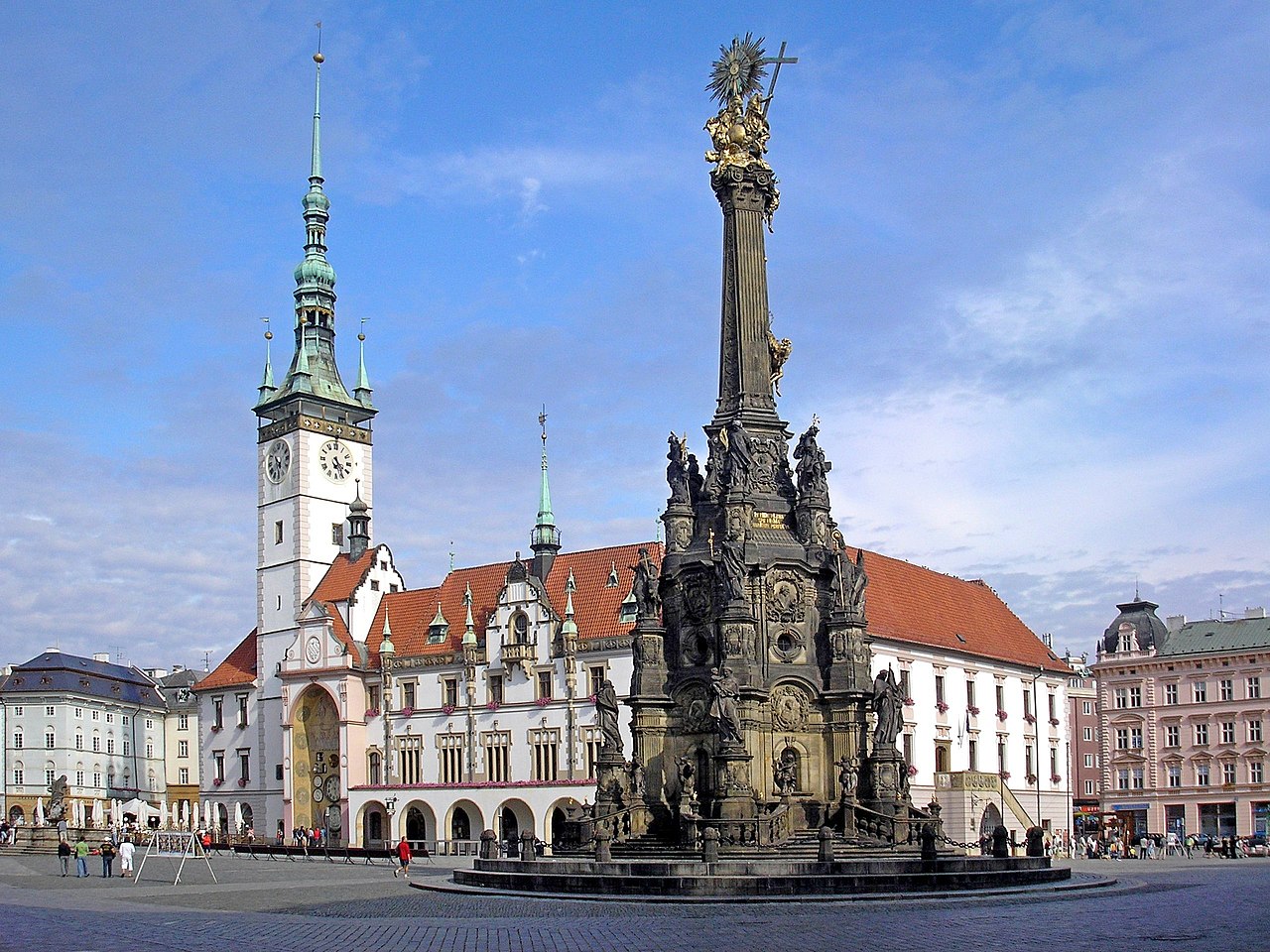
Olomouc (pronounced OH-loh-mohts) is a city of around 100,000 people in the heart of Moravia, set on the Morava river between the fertile Haná plain and the foothills of the Jeseníky mountains. For most of its history it was the ecclesiastical and administrative capital of Moravia — a royal city, home to the second-oldest university in the country (founded 1573), and to this day the seat of the Archbishop of Olomouc. Its old town centres on two grand squares, six Baroque fountains, a UNESCO-listed Holy Trinity Column, and one of the strangest and most memorable astronomical clocks in Europe.
It is a small city that punches enormously above its weight — architecturally, spiritually and culinarily — and one of the best kept secrets in Czech travel.

02
Chapter Two
Why Visit Olomouc
Olomouc is the answer to a question a lot of thoughtful travellers ask by their third day in Prague: is there somewhere in this country as beautiful, but where I can actually hear myself think? The old town is UNESCO-inscribed for the Holy Trinity Column alone, but the whole ensemble — two vast squares, six Baroque fountains, a Gothic town hall, a Neo-Gothic cathedral, an 18th-century archbishop's palace — is on the same level of quality as Prague's Old Town, with roughly 5% of the crowds.
And because it is a university town, it is alive. Around 20,000 students at Palacký University give the centre a genuinely young, cosmopolitan feel: excellent coffee bars, craft-beer taprooms, small independent bookshops, and terraces packed until midnight in summer. Combined with prices around 30% below Prague and some of the best Moravian cooking in the country, Olomouc is one of the most rewarding two-night stops on any Czech itinerary.

Chapter Three
Top Things To Do in Olomouc
Six landmarks give you the shape of the city — a UNESCO plague column, two great squares, a socialist-era astronomical clock, a thousand-year-old cathedral, a set of Baroque fountains you can walk in a loop, and a Baroque palace with an imperial coronation to its name.

Holy Trinity Column (UNESCO)
The Holy Trinity Column is the largest Baroque sculptural monument in Central Europe and the reason Olomouc's centre is a UNESCO World Heritage Site. Rising 35 metres above the Upper Square, it was built between 1716 and 1754 in gratitude for the end of a plague epidemic — an extraordinary act of civic ambition for what was then a provincial Habsburg town. The column is entirely covered in figures: eighteen saints, twelve apostles, angels, and a gilded sculpture of the Holy Trinity at its crown. Inside the base is a small chapel that a handful of visitors ever see.
Local Tip
The chapel inside the plinth is open only a few days a year (usually around major church holidays). Even without going in, walk a full slow circle around the base to appreciate the sculpture — most visitors photograph one side and move on.

Book Ahead
Olomouc Attractions & Tours
Small-group tours and limited daily entries fill first on summer weekends — reserve before you arrive in Olomouc.
Upper Square (Horní náměstí)
Olomouc's Upper Square is one of the great civic spaces of Central Europe — huge, sloping, framed by pastel Baroque and Renaissance façades, and anchored by the Gothic town hall with its slender 75-metre tower. Around the town hall stand the Holy Trinity Column, four of Olomouc's six famous Baroque fountains, and a scattering of cafés with terrace tables that are among the loveliest in the country. Unlike Prague's Old Town Square, this one still feels like a working piece of a Moravian city — locals cross it on their way to work, students meet at the fountains, and Saturday farmers' markets fill it with food stalls.
Local Tip
Take a seat on the terrace of Café Mahler or Konvikt in the late afternoon — the sun catches the pastel façades from the west and the whole square glows. This is the most Instagrammed moment in Olomouc, and it costs the price of a coffee.

Olomouc Astronomical Clock
Set into the north wall of the town hall on the Upper Square, the Olomouc Astronomical Clock is genuinely unique — it is one of only a handful of monumental medieval astronomical clocks in the world, and the only one rebuilt in socialist realist style. The original 15th-century clock was destroyed in the last days of the Second World War; when it was rebuilt in 1955, the traditional religious figures were replaced with workers, farmers, athletes and scientists, and the mosaic backdrop turned proletarian. It is fascinating, slightly kitsch, and unforgettable.
Local Tip
The clock's mechanical procession plays every day at noon (12:00 sharp). Arrive five minutes early to get a spot directly in front of the clock — it is a small, quiet moment compared to Prague's, and all the better for it.

St. Wenceslas Cathedral
St. Wenceslas Cathedral stands on the ancient Přemyslid castle hill (Václavské náměstí), a few minutes' walk east of the old town. Founded in 1107 and rebuilt in Baroque and then Neo-Gothic form, it is Moravia's mother church and — with its 100-metre south tower — the second-tallest church tower in Czechia after Plzeň. The interior is high, pale and unusually harmonious; the adjacent Přemyslid Palace houses the Archdiocesan Museum, a genuinely excellent collection covering a thousand years of Moravian religious art.
Local Tip
Combine the cathedral with the Archdiocesan Museum next door — it is one of the best small museums in the country, English-labelled throughout, and rarely busy. Allow an hour for the museum, twenty minutes for the cathedral.
The Baroque Fountains
Olomouc has six great Baroque fountains, an ensemble unmatched anywhere in Europe. Commissioned in the late 17th and early 18th centuries when the city refused to demolish its old fountains as neighbouring towns had done, each is dedicated to a classical figure: Caesar, Hercules, Jupiter, Mercury, Neptune and Triton. A seventh, modern Arion Fountain (2002) sits between them. Together they form a walking tour in themselves — a loop that leads you through both the Upper and Lower Squares and past most of the old town's finest façades.
Local Tip
Pick up the free 'Fountain Walk' map from the tourist office on the Upper Square (inside the town hall). Doing all six on foot takes about 45 minutes and is the single best way to orient yourself on your first afternoon.

Archbishop's Palace
The Archbishop's Palace, on Wurmova street between the cathedral and the old town, is one of the great secular Baroque interiors in Central Europe — and one of the least visited. It was here that the young Franz Joseph was crowned Emperor of Austria in December 1848, and here that Mozart lived briefly as a twelve-year-old, composing his Sixth Symphony while recovering from smallpox. Guided tours (Czech and English, in season) show the throne hall, the coronation hall and the archbishop's private chapel, all in staggering condition.
Local Tip
The palace is open for guided tours only, on a limited schedule (usually weekends and select weekdays, April–October). Check the current timetable at the tourist office the day you arrive and buy your ticket in advance — English tours are less frequent than Czech ones.
04
Chapter Four
Food, Cafés & Local Life
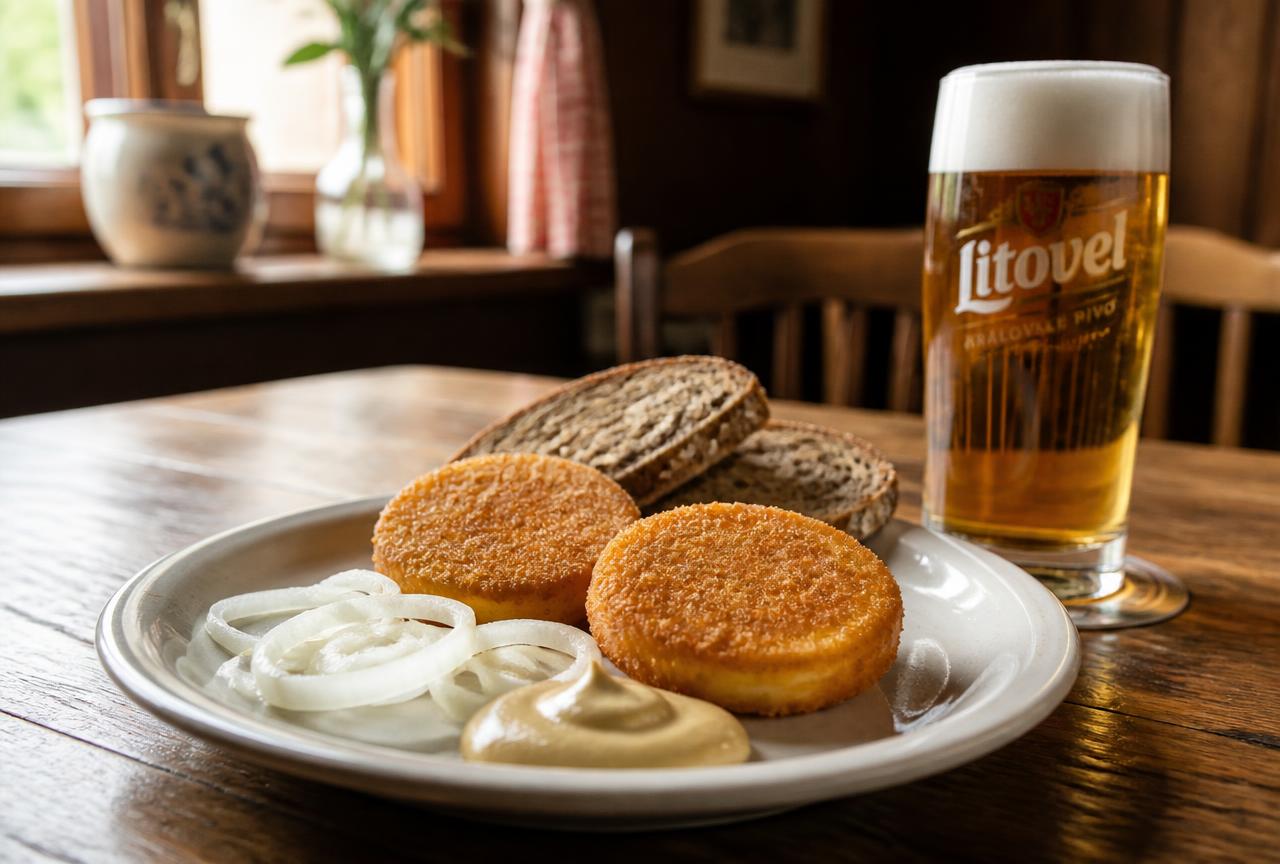
Traditional Moravian cuisine. Olomouc is the home of the country's most notorious cheese — Olomoucké tvarůžky, small ripened curd cheeses with a legendary pungent smell and a devoted local following. Try them fried in beer batter (smažené tvarůžky) at Moravská Restaurace on the Upper Square, or in the classic pairing with a glass of pilsner at U Bakaláře. For a full Moravian meal — roast duck with red cabbage and bread dumplings, or beef in cream sauce with cranberries — the two names locals send you to are Entrée Restaurant (contemporary, chef-driven) and Restaurace Konvikt (traditional, on the Lower Square).
Local cafés. Olomouc has one of the best specialty coffee scenes in the country. Café Mahler on the Upper Square is the historic favourite — high ceilings, Gustav Mahler memorabilia, and window tables that look straight at the Trinity Column. Long Story Short Café and Coffee Library are the young specialty roasters everyone raves about. Café 87, right next to the Archdiocesan Museum, is famous for its dark chocolate pie — try it once and you'll come back a second day.
Craft beer spots. The city's craft-beer scene has exploded since 2015. Riegrovka is a beloved, slightly scruffy taproom near the university with 20 rotating Czech craft taps. Chomout is a Moravian farmhouse brewery with a stylish tasting room on Dolní náměstí, and Beer Geek is the beer-nerd destination — international rarities and local micros in equal measure. For classic Czech pilsner in a beautiful vaulted cellar, try Svatováclavský pivovar, brewing on site since 2008.
Student atmosphere. Term time (October–May) transforms the city — the Lower Square (Dolní náměstí) becomes an open-air living room in the evenings, the cafés fill up with students working on laptops, and the club scene around Belmondo Riverside and S-club hums until 3 a.m. Summer is quieter but the terrace culture takes over and locals reclaim the squares.
Local tip
Buy a small tin of tvarůžky from any supermarket to take home — they cost about 60 CZK and, sealed, will survive the flight. They are one of only three Czech foods with EU Protected Geographical Indication.
05
Chapter Five
A Suggested One-Day Walking Itinerary
9:00 — Coffee on the Upper Square. A slow espresso at Café Mahler or Long Story Short. Watch the square wake up around you.
10:00 — Holy Trinity Column & town hall. A full slow loop around the column, then buy a ticket at the tourist office in the town hall for the tower climb — the best rooftop panorama in the city.
11:55 — Astronomical Clock. Position yourself in front of the clock a few minutes before noon for the mechanical procession. It's brief, quirky and worth the wait.
12:30 — Lunch on the Lower Square. Head down through the arcades to Dolní náměstí. Try Moravská Restaurace for smažené tvarůžky and a Pilsner, or U Bakaláře for a full Moravian roast.
14:00 — Fountain walk. Grab the free fountain map from the tourist office and walk the loop: Caesar, Hercules, Jupiter, Mercury, Neptune, Triton, and the modern Arion. About 45 minutes at a wander.
15:30 — St. Wenceslas Cathedral & Archdiocesan Museum. Walk east across Náměstí Republiky to the cathedral hill. Half an hour in the cathedral, an hour in the museum — one of the best small museums in Czechia.
17:00 — Coffee & chocolate pie at Café 87. A short walk downhill for the city's most famous cake and a second wind.
18:00 — Sunset stroll through Bezručovy sady. The long ribbon of park along the old city walls south of the centre is where locals walk at golden hour. Emerge near the Lower Square for dinner.
19:30 — Dinner and a beer. Book Entrée for a contemporary Moravian tasting menu, or drop into Svatováclavský pivovar for hearty pub food and their own lager. Finish with a nightcap at Chomout or Beer Geek.
06
Chapter Six
Where To Stay
Boutique — Miss Sophie's Olomouc, a beautifully restored townhouse three minutes from the Upper Square with genuinely stylish rooms and an excellent breakfast, and NH Collection Olomouc Congress, a sleek 4-star with a rooftop bar overlooking the old town spires. Both put you within an easy walk of everything.
Mid-range — Hotel Trinity occupies a 15th-century building right on the Upper Square with views onto the Holy Trinity Column itself; Theresian Hotel & Spa combines historic rooms with a small wellness area a five-minute walk from the centre. Doubles typically 2,200–3,800 CZK with breakfast.
Budget — Poets Corner Hostel is a warm, well-run hostel with private rooms and dorms two blocks from the Upper Square, and Long Story Short Hostel & Café is the design-forward choice — private doubles from around 1,400 CZK, with the excellent café attached. Airbnbs in the streets around Palacký University are excellent value.

07
Chapter Seven
How To Get There
Prague to Olomouc by train. Fast, frequent and comfortable. Direct trains run at least hourly from Prague hl.n. to Olomouc hl.n. and take about 2 hours 15 minutes. The best services are RegioJet and Leo Express, both with modern coaches, free coffee and reserved seats from around 250–450 CZK. State operator České dráhy (ČD) also runs the route at similar speed on its Pendolino trains.
Prague to Olomouc by bus. RegioJet and FlixBus run frequent direct coaches from Prague Florenc to Olomouc Terminal Hlavní nádraží, taking about 3 hours 15 minutes. Tickets often start at 149 CZK. Buses are excellent quality in Czechia — modern coaches, Wi-Fi and on-board coffee — but the train is genuinely faster and more scenic on this route.
Driving. Olomouc is about 280 kilometres east of Prague on the D1 and D35 motorways — normally around 2 hours 45 minutes, but the D1 can be congested on Friday afternoons and Sunday evenings. Central parking is limited and expensive; use one of the P+R lots on the ring road (Šantovka, Šibeník) and take the tram in. If you're continuing to the Jeseníky mountains or Kroměříž, a car is genuinely useful.
Onward connections. Olomouc sits on the main Prague–Ostrava line and is a natural stop if you're travelling on to Kraków (about 4 hours by train via Ostrava) or Vienna (about 3 hours 30 minutes via Břeclav). If you're building an eastward Central European route, Olomouc is one of the most rewarding places to break the journey.
08
Chapter Eight
Day Trips From Olomouc
Kroměříž (45 km south-east). The single most rewarding day out from Olomouc. Kroměříž's Archbishop's Chateau and its two great gardens — the Baroque Flower Garden and the vast Chateau Garden — together form a UNESCO World Heritage Site, and one of the most beautiful ensembles of gardens in Central Europe. Buses from Olomouc take about an hour; by train, change at Hulín (about 1 hour 15 minutes total). Allow a full day.
Moravian Karst & Macocha Abyss (70 km south). A dramatic limestone landscape of caves, gorges and the 138-metre Macocha sinkhole. The Punkva Caves tour ends with a boat ride along an underground river. From Olomouc, drive via Prostějov (about 1 hour) or train to Blansko via Brno (about 2 hours). Best done with a car or as a full-day guided trip.
Litovel (25 km north-west). A small brewery town nicknamed "the Venice of Haná" for the six branches of the Morava river that thread through the centre. Home to the excellent Litovel brewery (tours available) and the surrounding Litovelské Pomoraví protected landscape — flat, quiet cycling country between forested wetlands. Easy 25-minute train from Olomouc; a great low-key half-day.
Jeseníky Mountains (60–100 km north). Czechia's second-highest range, with Praděd (1,491 m) as its summit — a landscape of round wooded ridges, spa towns and quiet hiking. The best base for a day trip from Olomouc is Karlova Studánka, a Baroque spa village in the valleys below Praděd. Reachable by bus in about 2 hours or car in 1 hour 30 minutes. In winter, the ski areas at Ovčárna and Karlov pod Pradědem are worth the drive.
Chapter Nine · FAQ
Frequently asked.
Is Olomouc worth visiting?+
Yes — for a certain kind of traveller, it's the single most rewarding second city in Czechia. If you want UNESCO-quality architecture and genuine Moravian atmosphere without the crowds of Prague or Český Krumlov, this is where to go.
How many days do I need in Olomouc?+
One full day covers the main sights (Upper and Lower Squares, cathedral, fountain walk, astronomical clock). Two nights is the sweet spot — one day for the city, one for Kroměříž or the Moravian Karst.
Can I do Olomouc as a day trip from Prague?+
Technically yes (2 hours 15 each way by fast train) but you'll spend as much time on the train as sightseeing and miss the evenings, which are the best of it. Overnight if you can.
Is Olomouc cheaper than Prague?+
Meaningfully cheaper for food, drinks and hotels — expect prices roughly 25–35% below central Prague, and craft-beer bars that would be double the price in Prague 1.
Do people speak English?+
Widely, especially in cafés, restaurants, hotels and museums in the centre. Olomouc is a university city with a large international student population — you'll rarely have language trouble.
Why is the astronomical clock so different from Prague's?+
The original 15th-century clock was destroyed in the final days of the Second World War. The socialist-era rebuild in 1955 replaced the religious figures with workers, farmers and athletes, and reworked the mosaics in proletarian style. It's the only monumental astronomical clock in the world rebuilt this way — and unforgettable for it.
What's the best time of year to visit?+
Late April through mid-October, with peaks in May–June (blossom, mild weather, terraces open) and September (university back in session, but still warm). Winters are cold but atmospheric; the Christmas market on the Upper Square is one of the loveliest in the country.
Continue exploring
Nearby & related destinations


The Wonders Dispatch
Get Czechia travel tips, itineraries and hidden gems delivered by a local.
One quiet letter a month from Lukáš in Prague. No spam, no sponsored fluff — just the notes I'd send a friend planning their trip.
Free · Unsubscribe any time · Read by travelers in 40+ countries